Mindfulness, Guided conversations
Choose a conversation mode for the kind of reflection you want
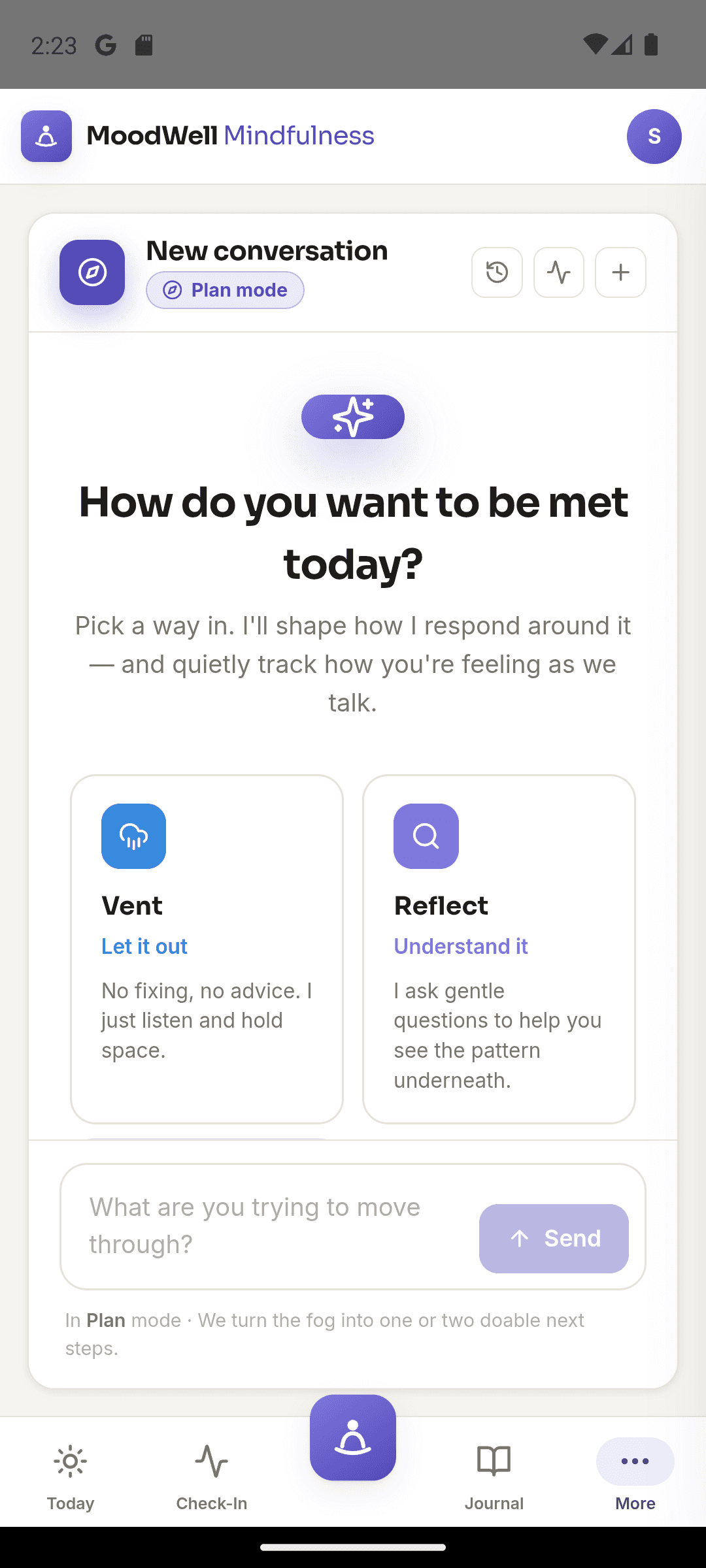
Choose Vent when you want to put something into words, Reflect when you want to explore it, Plan when you want a practical next step, or Calm when you want a brief present-focused exchange. These modes shape Guided Conversations; they are separate from the named AI coach personas.
Which guided conversation mode should you choose?
Before opening a guided conversation, ask what kind of exchange would be useful. You may want to express frustration without immediately receiving a list of tasks, examine a situation more closely, or decide on something practical. These are different starting points. Choosing one does not mean the others are wrong or that you must know exactly where the conversation will end.
Moodwell Guided Conversations offers Vent, Reflect, Plan, and Calm. The modes guide the approach of the AI response. They are distinct from the named personas in the AI coach directory. Choosing a coach elsewhere is not the same action as selecting how you want to begin this reflection session. The persona (13 of them, Nell Okafor by default) changes how the coach sounds. The mode changes what it tries to do. You can keep a persona you like and pick a different mode for the next session.
What does each guided conversation mode do?
Vent is oriented around hearing what you want to express, rather than immediately proposing solutions. Reflect emphasizes questions and tentative observations. Plan moves toward a small, practical next step. Calm uses a shorter, present-focused approach instead of asking you to analyze the whole situation. Read the mode descriptions and choose what fits your purpose.
The mode is a starting instruction for AI, not a guarantee about every reply. You can clarify what you need in your message, correct an assumption, or stop an exchange that is not useful. Vent still replies, but the brief is to listen and hold space rather than suggest. If you find yourself wanting a next step partway through, say so, or start a Plan session with what you have worked out. Your description of the situation still supplies the context for the conversation.
- Do I want to be heard before considering suggestions?
- Is there a question I want to explore without deciding immediately?
- Am I ready to choose a practical action that fits my circumstances?
- Would a brief exchange fit better than a detailed discussion right now?
The four modes as the app describes them
Each mode has a one-line description in the drawer. Vent is “Let it out”, and its fuller line is “No fixing, no advice. I just listen and hold space.” Reflect is “Understand it”. Plan is “Move forward” and is the default, so a session you start without choosing lands here. If you want to be heard before anything is proposed, choose Vent before sending the first message; its description promises no fixing and no advice. Calm is “Settle down”. The mode sets the coach’s approach; the persona, Nell Okafor by default and one of 13, sets the voice. Changing one does not change the other.
Whatever the mode, the mechanics are the same. Each reply costs 1 AI credit with no per-message label, the server keeps the last 60 messages as context, and the sources the coach may draw on (Fitness, Nutrition, Plan, Connected device summaries) are off until you switch them on under “What your coach can use”. Health records and Journal text are never included in any mode. Recent conversations keeps earlier sessions with automatic titles, and any of them can be deleted.
- Session read, in the side panel, shows Mood, Clarity, Stress and “What I’m noticing” for the current session.
- Save to journal works on any reply, in any mode; Vent sessions are often the ones worth keeping.
- “Wrap up with a recap” gives a Session recap with “Save recap to journal” and “Turn into a goal”; the second makes most sense after Plan.
- Calm is a conversation. For a wordless pause, the Free breathing tools cost no credits.
Calm is not a replacement for a breathing exercise. Calm is a short, present-focused exchange that still costs 1 credit per reply. Breathing Coach, Box Breathing Trainer and the 4·7·8 Breathing Guide are Free tools with no typing, and for some moments they fit better.
A decision one day, an unresolved conversation another
After a frustrating meeting, you might choose Vent and say: “I want to put this into words before deciding what to do.” On another occasion, the facts may already be clear and you want to prepare a follow-up question. Plan could be a more useful starting point for that task.
If you are unsure why one part of the meeting stayed with you, Reflect may fit the question better. Describe the actual exchange and your uncertainty. The choice is about what you want to do with the conversation, not an assessment of your mental state or a requirement to follow a fixed sequence of modes.
Evaluate the reply as a suggestion
Guided conversations use AI credits. Read the response against the facts you supplied and notice where it introduces an assumption. A tentative interpretation can be worth considering without becoming the explanation you adopt. When a practical suggestion depends on information you have not provided, clarify that before deciding whether it fits.
The guide is AI, not a human professional or a clinical service. A useful result might be a clearer question, a short account of what happened, or one action to consider. You can revisit the session later with new context, but you do not need to keep generating replies merely to reach a neat conclusion.
Related Moodwell feature
Choose how to begin a focused reflection
Guided Conversations offers Vent, Reflect, Plan, and Calm modes within sessions you can revisit.
Explore guided conversations