Mindfulness, Daily Focus
A morning routine for a clearer start
A short morning routine can have three parts: record how you feel, look at today's commitments, and choose one intention. In Moodwell, combine Mood Check-In, the day planner, and Daily Focus. Keep a shorter version for rushed mornings instead of trying to complete every tool every day.
A morning routine does not need to optimize every part of your life. Its job can be simpler: notice how you are arriving, remember what matters today, and choose the first useful action.
Build it around the time and energy you actually have. A repeatable five-minute routine is more useful than an elaborate plan you avoid.
What does a five-minute morning routine look like?
Check in, scan the day, choose a focus, and start small.
Example: the Daily Focus answers for a rushed Thursday might be Stressed, Work, Clarity, and “Budget review at 10 and I haven’t opened the file.” The plan’s small win could then be fifteen minutes with the file before anything else, which is the fourth step of this sequence done for you.
- 1
Check in
Record your mood, energy, and stress without trying to change them yet.
- 2
Scan the day
Look at planned workouts, meals, health items, and commitments.
- 3
Choose a focus
Write one intention you can return to when the day becomes noisy.
- 4
Start small
Pick the first action that takes the plan from idea to motion.
Write a focus you can use
A useful focus describes how you want to approach the day rather than trying to control its outcome. ‘Pause before I answer’ is easier to apply than ‘Have a stress-free day.’
- Finish the most important draft before checking optional messages
- Eat lunch away from the desk
- Ask one clarifying question before making an assumption
- Keep the evening plan light after a full day
How does Daily Focus fit into the morning?
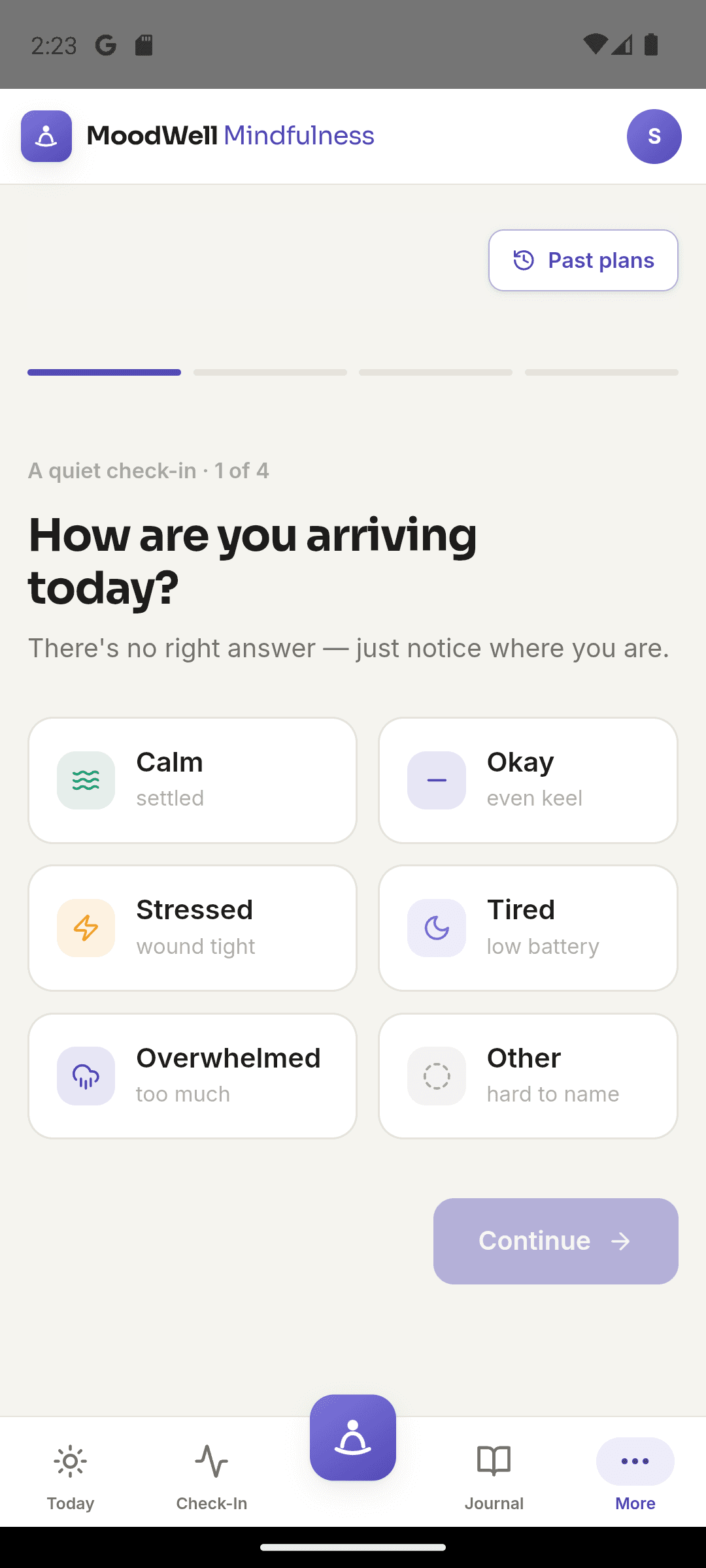
Daily Focus asks how you are arriving today, what is taking up space, what would help most, and what is weighing on you. Answer from today's situation. For example: you feel distracted, work is occupying your attention, and you want a calmer start before a busy afternoon.
Read the generated guidance and select the focus action you want to carry into the day. Later, use the close-the-loop reflection to look back at that intention. Daily Focus uses AI guidance, so it requires available credits; a mood check-in and a look at your planner can still form the short version of your morning routine.
You don’t need a check-in before Daily Focus. It asks its own four questions, starting with “How are you arriving today?” (Calm, Okay, Stressed, Tired, Overwhelmed or Other). A check-in first helps you answer honestly, but neither step depends on the other.
When the morning runs short or the plan runs out
Some mornings will begin late or under pressure. Use a one-minute version: name your state, read the day plan, and choose the next action. The routine should support the day you have, not become another standard you failed to meet.
Daily Focus uses 1 credit each time you tap “Create my focus”, and on the free plan it runs once per local day. A second attempt that day returns the same plan with an “Upgrade” banner rather than a new one, so answer the four questions with the day you actually have, not the day you hoped for. The last question, “Anything weighing on you?”, is a 280-character box, which is room for one worry, not a list.
On the free plan you can’t redo Daily Focus later the same day. The same plan comes back until the next day, so if the morning changes, change the intention yourself and keep the plan for the “Tonight” question.
The plan is more than a single focus line. “Start with one small win” offers three actions with times and a “Start now” button, with “Or choose a different win” if the first doesn’t fit. “If today gets messy” gives an obstacle and an if-then, and “Tonight” asks a close-the-loop question that is still waiting for you in the evening. “Past plans” keeps earlier days, and the “Helpful?” thumbs let you say whether a plan worked.
The “Tonight” question closes the loop on the intention. In the evening it asks how the focus went, and “I remembered once” is a valid answer. That record is what makes tomorrow’s routine better informed than today’s.
- When Daily Focus isn’t available, a check-in and the day view of the planner are still the short version of the routine.
- “A gentler thought” rewrites one thought from old to new. If it doesn’t land, leave it; the small win is the part that moves the morning.
- Daily Focus works from your four answers. The commitments you scan in step two live in the planner, not in the plan it writes.
- The focus is yours to change by noon. Nothing in the plan is a commitment the app checks on, apart from the “Tonight” question you answer yourself.
Related Moodwell feature
Set a Daily Focus
Use a short intention and the day's available guidance to begin with a clear direction.
Explore Daily Focus