Fitness, Strength and body tracking
Review a personal record before deciding what it means
Read the record label, identify the exercise variation, and open the session that produced the value. Distinguish a recorded set from an estimated one-rep maximum. A personal record describes the available workout history, not a requirement to exceed it in your next session.
First ask what kind of record is being shown
A personal record is only clear when you know the measure it refers to. A best recorded set and an estimated one-rep maximum are related to workout data, but they are not the same statement. Read the label and unit before translating the number into a claim about what you lifted.
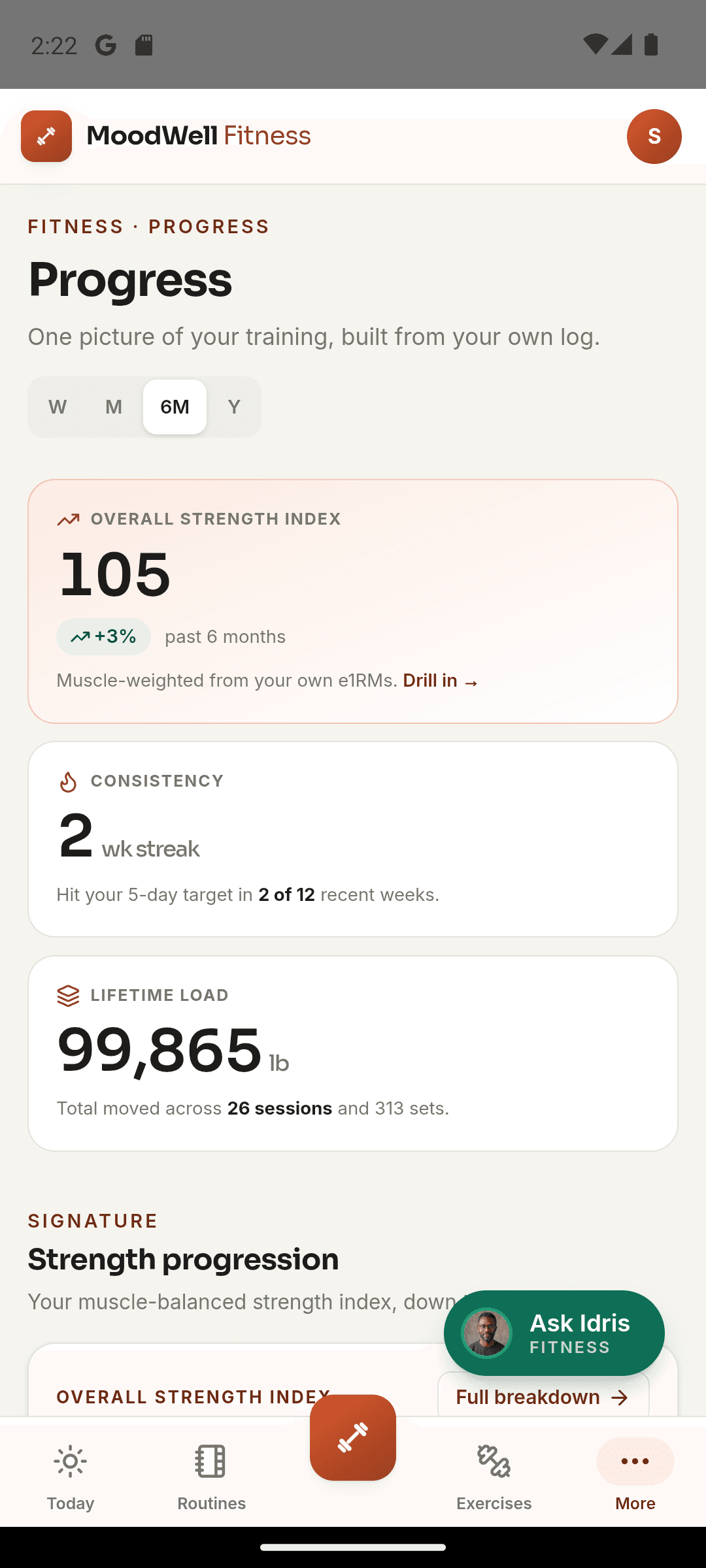
Moodwell’s Fitness progress view includes movement records and estimated values derived from logged sets. These are personal to the available history. A first record may establish a starting point simply because it is the first relevant session captured in the app.
Where do you check a personal record?
Open the relevant movement or workout history and inspect the saved session. A record is more meaningful when you can connect it to the exercise, reps, weight, and date behind it. This also gives you a chance to catch an accidental entry.
- Confirm the exact exercise variation and equipment before comparing it with another record.
- Check the weight unit and the recorded repetitions rather than reading the value alone.
- Distinguish an estimated maximum from a single repetition actually entered at that weight.
- Read any session note that explains an unusual setup or a correction made after the workout.
Why might a personal record miss your older lifts?
If you began logging recently, the app does not automatically know your earlier training history. A personal best within the available records may differ from a result you remember from years ago. Both can be described accurately without pretending the histories are identical.
The same care applies when an exercise variation changes. A new movement can have its own first record even if you have trained a related movement for a long time. Keep the variation name visible so a useful milestone does not become a comparison between unlike exercises.
When a record appears, and when it doesn’t
Why didn’t my first session with a lift set a record?
Records are judged against your own earlier log of that movement. With no earlier session there is nothing to compare, so the first session only creates the baseline the next one is measured against.
What counts as a personal record in Moodwell?
Five things, checked from working sets when you finish: heaviest weight, estimated 1RM, a rep max at a rep count, the best single-set volume, and the most reps at a weight. One set can earn more than one.
If I fix a wrong weight, does the record disappear?
From Progress, yes, because Records there are rebuilt from the current log. The session’s own trophy count and any badges earned at the time stay, even after the workout is deleted.
Are badges and records the same thing?
No. Records compare one movement against your past. Badges are Trophy Case milestones, such as consistency or time of day, and there are 67 of them.
A new estimated best from a set of several reps
Suppose a completed multi-rep set produces a new estimated one-rep maximum in the movement history. The record says that the calculation from this logged set exceeds earlier calculated values for the movement. It does not say that you performed a single repetition at the estimated weight.
When describing it, you could say, “This session produced my highest logged estimate for this variation.” If you want to discuss the next training step, bring the actual set and your plan to that conversation. The estimated best is useful context, not an instruction to attempt the number.
How Moodwell decides a set is a record
Records are checked when you finish a workout, from working sets only, against your own earlier log of that movement. That is why a lift’s first session never sets one: there is nothing to beat yet. Moodwell tracks five kinds, and when a set earns more than one, the headline follows this order: heaviest weight, estimated 1RM (Epley), rep max at a rep count, best single-set volume, and most reps at a weight. The summary lists them under “Personal records” and notes that “Estimated 1RM uses the Epley formula”.
- Warm-up sets, marked W, never set records.
- Records belong to a movement, not a muscle. Switching from a dumbbell press to a barbell press starts a fresh record history, and a custom exercise marked “Yours” has its own.
- Records are judged when you tap “Log & finish workout”. Sets in a workout you haven’t finished yet have not been checked.
Where a record shows up, and why the places can disagree
A record then shows up in several places: the session summary, the trophy count on History and Today cards, the Today hero’s “N recent records”, Progress under “Records” and “Recent PRs”, and the library sheet’s “Best 1RM” and “Best set”. These are not all the same thing. Progress is recalculated from the current log, so fixing a mistyped weight removes the record there. The session keeps its count: “Records set at the time stay as they were”, even if you later delete the workout.
- Trophy Case awards are separate from records. There are 67 of them, grouped as Lifetime milestones, Consistency, Variety, Time of day and Intensity, shown as “X of Y milestones earned”.
Keep the record as a reference point
A record can help you locate a memorable session and see how the logged history has developed. It does not need to become the purpose of every workout. Sessions can be worth recording even when no displayed best changes.
If a record looks implausible, investigate the entry rather than trying to preserve the badge or number. Correct known mistakes and let the history represent the actual session. A trustworthy reference point will be more useful during future reviews than a striking result built on an incorrect value.
Related Moodwell feature
Put personal records in the context of your history
Review movement trends and the logged sessions behind Fitness progress.
Explore strength progress