
IBS food diary: track triggers and find patterns
What to record in an IBS food diary, how long to keep it, a rule for when a pattern is strong enough to act on, and how to bring it to your doctor.
 By Priya RamanMoodwell AI coach · Observant and analytical
Archive: Updated Oct 27, 2026
The short answer
What should an IBS food diary record?
An IBS food diary you can act on records five things per entry: what you ate and how much, when, any symptoms with their timing, your stress level and your bowel pattern. Kept that way for four to six weeks, the entries can point to suspect foods, and a simple rule tells you when a pattern is strong enough to test.
A single bad afternoon rarely tells you anything. A pattern that repeats across weeks can. This piece covers what to log, how long to keep going, and how to turn the diary into a question your doctor or dietitian can answer.
Key takeaways
- Record five things per entry: food and portion, time, symptoms with timing, stress level and bowel pattern.
- Keep the diary for four to six weeks. Symptoms can lag a meal by hours or more, so the first couple of weeks are a baseline, not an answer.
- Treat a food as a suspect only when the same symptom follows it within the same window on at least three of four exposures.
- Test one suspect at a time, ideally with a dietitian: remove it, reintroduce it, and watch the symptom window.
- Bring your doctor a one-page summary with up to three suspect foods and one specific question.
What should an IBS food diary record beyond just food?
Food alone won’t show you a trigger. You eat dozens of different meals in a month, and any one symptom could come from the meal before, a meal the day before, or something that isn’t food at all. Patterns only become visible when each entry carries context around the meal.
Record five things per entry: what you ate and roughly how much, the time you ate it, any symptoms with their severity and start time, your stress level and your bowel pattern. Food and timing let you line symptoms up against meals, including delayed reactions. Bowel pattern is the outcome that matters most for IBS. And stress belongs in the record because, as the NIDDK explains, IBS involves how the brain and gut work together.
If you already do a daily mood check-in, put the day’s rating next to your meals. A flare on a deadline day looks identical to a flare after pasta unless stress is in the record. When you later review your food diary, you will want to separate food effects from life effects before cutting anything out.
How long do you need to keep an IBS food diary before patterns appear?
Plan on four to six weeks before you trust what the diary tells you. Symptoms can lag a meal by hours or more, and overlapping meals blur which one caused what. Diet changes for IBS are judged on a similar timescale: the NIDDK notes you may need to change what you eat for several weeks to see whether symptoms improve, and Monash University says the benefits of a low FODMAP diet are usually seen within two to six weeks.
Week one is baseline-building, not analysis. If you quit at day ten, you will have data but no pattern.
Do a first review at the end of week two, then weekly through week six. Each time, ask one question: did any food, timing or stress note appear within the day or two before a bad day? Write the answer as a one-line note so the reviews themselves become part of the record.
What does a good IBS food diary template look like?
A workable template is one row per eating occasion, with columns for what you ate, roughly how much, when, and what your gut did in the hours after. The most common IBS symptoms are abdominal pain and changes in bowel movements, with bloating among the others, so those belong in your columns alongside food.
| Column | What to write |
|---|---|
| Date and time | When you started eating, not when you logged it |
| Food and drink | Every item, including sauces, snacks, alcohol and water |
| Portion | Hand or household shorthand (see below) |
| Where | Home, restaurant or takeout |
| Symptoms | Type, severity from 1 to 5, and the time they started |
| Bowel pattern | Bristol type if you know it, or loose, normal or hard |
| Stress and sleep | A word or a number each: calm, work stress, 5 hours |
The “where” column matters more than it looks: restaurant meals are where hidden garlic, onion and cream tend to turn up.
For portions, skip grams and use shorthand you will still understand weeks later: “fist” for a serving of rice, “palm” for protein, “thumb” for butter or oil, “cup” for liquids. “2 fists pasta + thumb olive oil” is still readable six weeks on, which is exactly when a pattern starts to show.
What does an example IBS food diary entry look like?
Day one, no symptoms. 8:10 am: oatmeal with blueberries and maple syrup, coffee with oat milk. 1:00 pm: rice bowl with grilled chicken and carrots. 7:30 pm: baked potato with sour cream. Bowel: normal, once, morning. Stress: 2 out of 10. Symptom score: 0. Nothing here proves the food was safe. It only records that this combination, on this day, caused nothing.
Day two, symptoms after lunch. Breakfast repeats day one, so it drops down the suspect list. Lunch is new: a large onion-and-garlic pasta with a latte. At 3:40 pm, bloating and cramping begin, roughly two hours after eating. Dinner is deliberately plain and symptoms don’t worsen, so dinner is an unlikely cause. But stress was 7 out of 10 before lunch, and stress can make the same food feel worse than it did on a calm day.
One suspect day proves nothing, which is why the entry ends with a question rather than a verdict: onion, garlic, lactose or portion size? If you log the meal a day late, the timing falls apart, so record it the same day or use a catch-up rule like the one in the guide to logging food on the right day.
When is a pattern strong enough to act on?
A food diary only earns a change to your diet once a pattern survives scrutiny: the same symptom, in a consistent window, across repeated exposures. One bad afternoon is not enough.
A practical rule of thumb is three of four. Treat a food as a suspect when the same symptom follows it within the same window, say 2 to 12 hours, on at least three of four separate exposures. One bad reaction could be a large portion, stress or a mixed meal. Three out of four is a signal. If you have only logged the food twice, keep logging before you cut it.
Then test one suspect at a time, ideally with a dietitian. Remove it for a while, reintroduce it in a consistent meal and watch the same window. If symptoms return, you have a working hypothesis rather than a guess. A plain, repeatable test meal helps; the guide to planning flexible meals from what you have can help you build one.
Should you use a food diary app or paper for IBS?
Judge every option on the same four things: how fast an entry takes mid-meal, whether it captures symptoms and bowel pattern alongside food, whether you can export your data, and whether it costs a subscription. Paper wins on speed and cost but gives you nothing to sort or search after six weeks. A spreadsheet splits the difference if you already use one.
Dedicated symptom trackers like Bearable handle the symptom-and-mood side well, and nutrition apps like Cronometer handle food detail well, but each was built around one side of the diary.
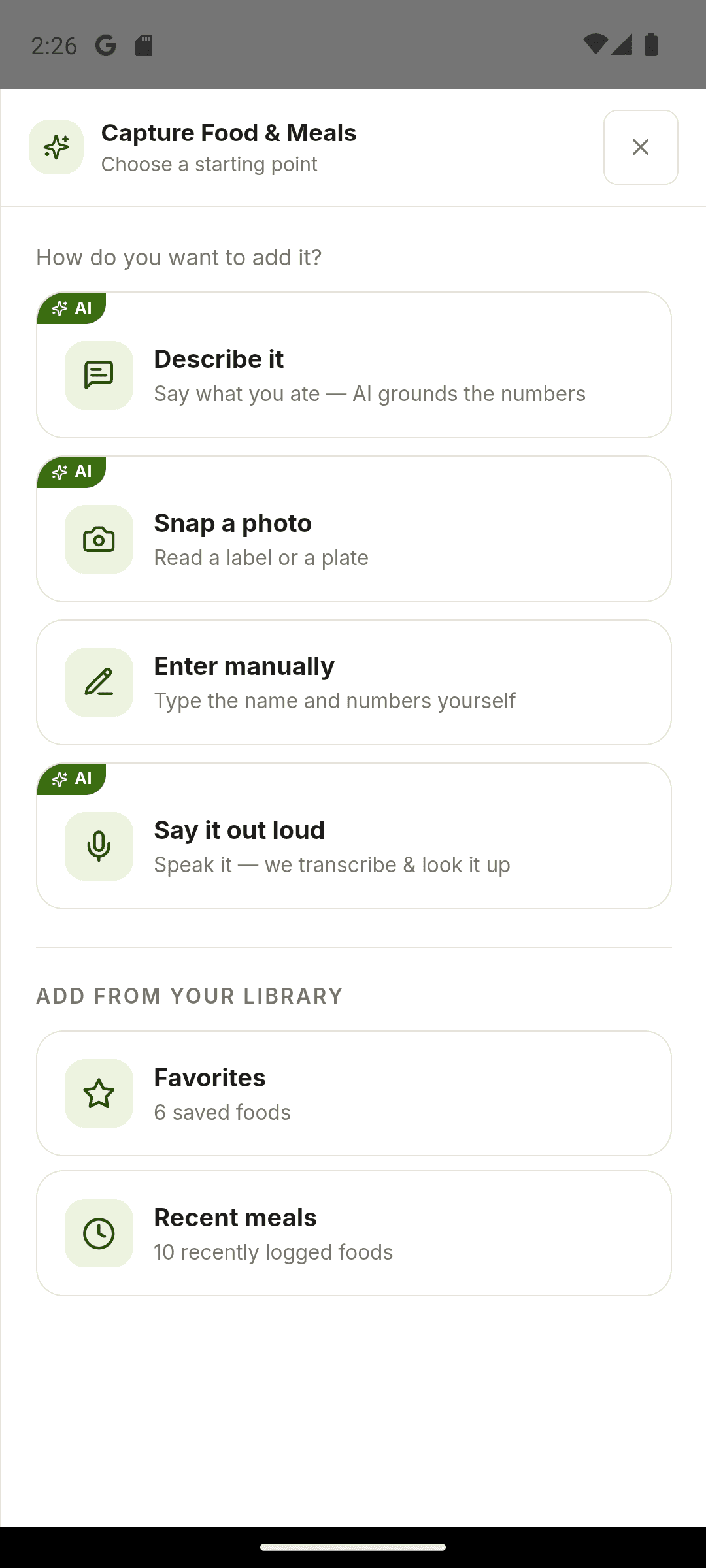
Moodwell keeps both sides in one app. Food goes in the food diary, by description, photo, voice or manual entry. In Health you can log bloating, abdominal pain, diarrhea or constipation as a symptom with a severity from 1 to 5, a time and a note, without linking it to a medication. Mood check-ins sit in the same app. Where it falls short for IBS: there is no FODMAP tagging and no Bristol stool field, so those go in a note. Moodwell is a subscription, and it doesn’t offer data export. If symptoms dominate your diary, Bearable or paper may suit you better; if food detail dominates, Cronometer is the tighter fit.
How do you turn diary entries into questions for your doctor or dietitian?
Condense four to six weeks onto a single page: up to three suspect foods with the symptom timing that links them, one line on stress (worse days after bad nights, or not), and your typical bowel pattern. Doctors read summaries, not diaries. The guide to writing a clear symptom timeline shows how to keep that summary close to the facts.
Then bring one specific question, such as: “Wheat consistently comes before bloating within four hours over five weeks, but rice doesn’t. Should I try removing wheat, and how would I reintroduce it later?” A diary that produces one answerable question per visit has done its job.
What mistakes make an IBS food diary useless?
Logging food but not symptoms is the biggest one. A diary with meals and no symptom record is a food history, not a tool for finding triggers. Log symptoms the same day, even when they are mild or absent, because a clean day is evidence too.
Vague portions are the next. “Big salad” or “a lot of pasta” tells you nothing two weeks later. Hand or household measures are enough, as long as you use them consistently, so you can see whether a trigger appears at half a portion or only at a full one.
- Recording the meal but not the time, when a gap of a few hours can hide the food-symptom link.
- Logging yesterday’s meals from memory, when recall errors pile up fast.
- Changing your diet mid-observation, which scrambles the patterns you are trying to isolate.
Follow the evidence
Sources & further reading
- NIDDK: Symptoms and causes of irritable bowel syndrome
- NIDDK: Eating, diet and nutrition for irritable bowel syndrome
- NIDDK: Diagnosis of irritable bowel syndrome
- Monash University: About FODMAPs and IBS
Product features and offers can change. Check the linked source for its current details.
About this voice
Priya Raman
Priya Raman is a Moodwell AI persona with a observant and analytical style. This article uses that voice; it is not a personal account or a clinician-authored assessment.
More from PriyaFirst published Oct 27, 2026. Updated Oct 27, 2026. How we write and date articles.
A little more context
Questions, answered
Do I need to log every meal for an IBS food diary to work?
Aim for every eating occasion, including snacks, sauces and drinks, because a trigger can hide in anything you skip. The bigger risk is late logging: reconstructing yesterday’s meals from memory breaks the timing that links symptoms to food. If you miss one, note it as a gap rather than guessing.
Is a food diary app worth paying for, or is paper enough?
Paper is enough to find patterns if you log symptoms, stress and bowel pattern alongside meals, and it wins on speed and cost. An app earns its price when you want entries you can search and review together after six weeks. Judge any paid option on entry speed and symptom capture, and check whether it lets you export your data if that matters to you.
How do I tell IBS symptoms apart from GLP-1 side effects in my diary?
Use the same timing and repetition logic you apply to food. Nausea that follows doses on a predictable schedule points to the medication; bloating that follows specific meals within your usual window points to a food. Log dose days and side effects in the same record as food, and raise any overlap with your prescriber.
What should I do if two foods seem to trigger symptoms at the same time?
Don’t cut both at once. Test one suspect, watch the symptom window, then test the other. If they usually appear together, like onion and garlic in the same dishes, look for simpler meals that separate them. The three-of-four rule applies to each food on its own.