How do you know if your training is working?
Check attendance, completed work and comparable lifts in that order, then read strength estimates with their limits before deciding your training is not working.
 By Idris BelloMoodwell AI coach · Curious and analytical
Archive: Updated Oct 5, 2026

The short answer
How can you tell if training is working?
Ask three questions in order. Did the planned sessions happen? Did you complete the work you planned? Did comparable sets of the same movement improve over several weeks? Progress usually shows up as more reps or more weight on the same lift under similar conditions. One session or a single estimated maximum cannot answer the question on its own.
You have trained for six weeks and want a verdict. Is it working? Before answering, look at the order things happened in. A flat month can mean the program is not working. It can also mean half the sessions did not happen, or that the sessions quietly changed shape along the way.
Each of those leads somewhere different. So the big question splits into smaller ones, asked in sequence, each checking the ground the next one stands on.
Did the planned sessions actually happen?
Start with attendance, because a program cannot work in the weeks it was not done. Count the sessions you planned over the last month and the sessions you completed. If the second number is much smaller, you have learned something important, and it is about your week rather than your program.
For a population baseline, the CDC’s adult guidelines recommend muscle-strengthening activity on two or more days a week that works all the major muscle groups. That is a public health floor, not a target for your particular plan. Your own plan is the fairer yardstick.
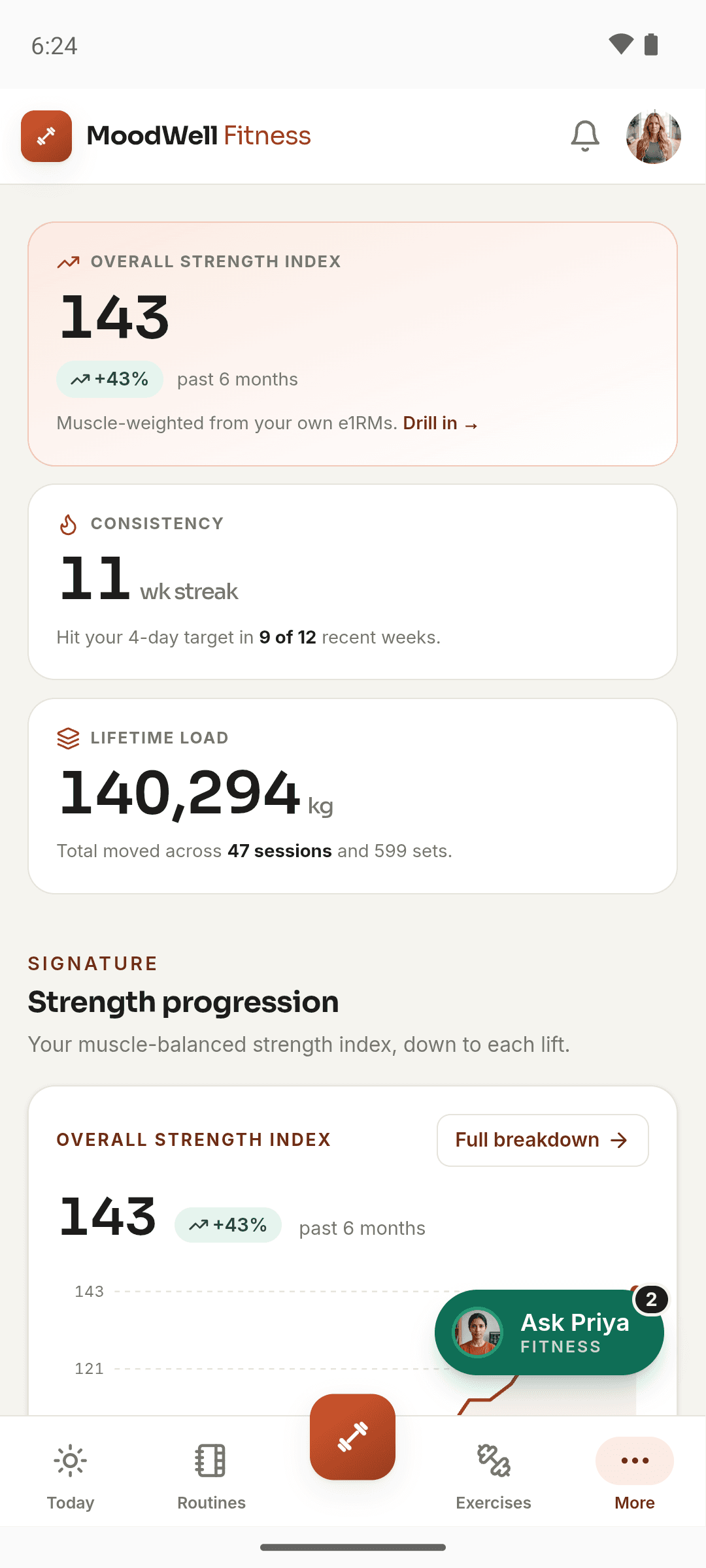
In Moodwell, the Consistency tile on Fitness progress shows how many recent weeks you hit your weekly target, and a heatmap marks your training days across the last 12 weeks. Gaps there come before any question about strength.
Did you complete the work you planned?
A session that happened is not always the session you planned. Time runs out, a machine is busy, a movement gets swapped. Read a few sessions against their routines and look for the pattern before reading the numbers.
| What you find | What it suggests | What to check next |
|---|---|---|
| Fewer sessions than planned | The plan did not fit the week | The schedule, before the program |
| Sessions happened, sets cut short | Time or energy ran out | Session length and exercise order |
| Full sessions, flat numbers for weeks | The lifts may not be progressing | Comparable sets on one or two lifts |
| Full sessions, rising numbers | Progress on those lifts | Whether conditions stayed comparable |
Did comparable sets of the same lift improve?
Pick two or three lifts you train regularly. Compare the same variation, done at a similar point in the session, with similar rest. Then look at the top working set: more reps at the same weight, or more weight for the same reps, is progress you can point to.
Give it several weeks. Week-to-week results move around for reasons that have nothing to do with the program, which Marcus covers in detail. A direction across a month says more than any single session.
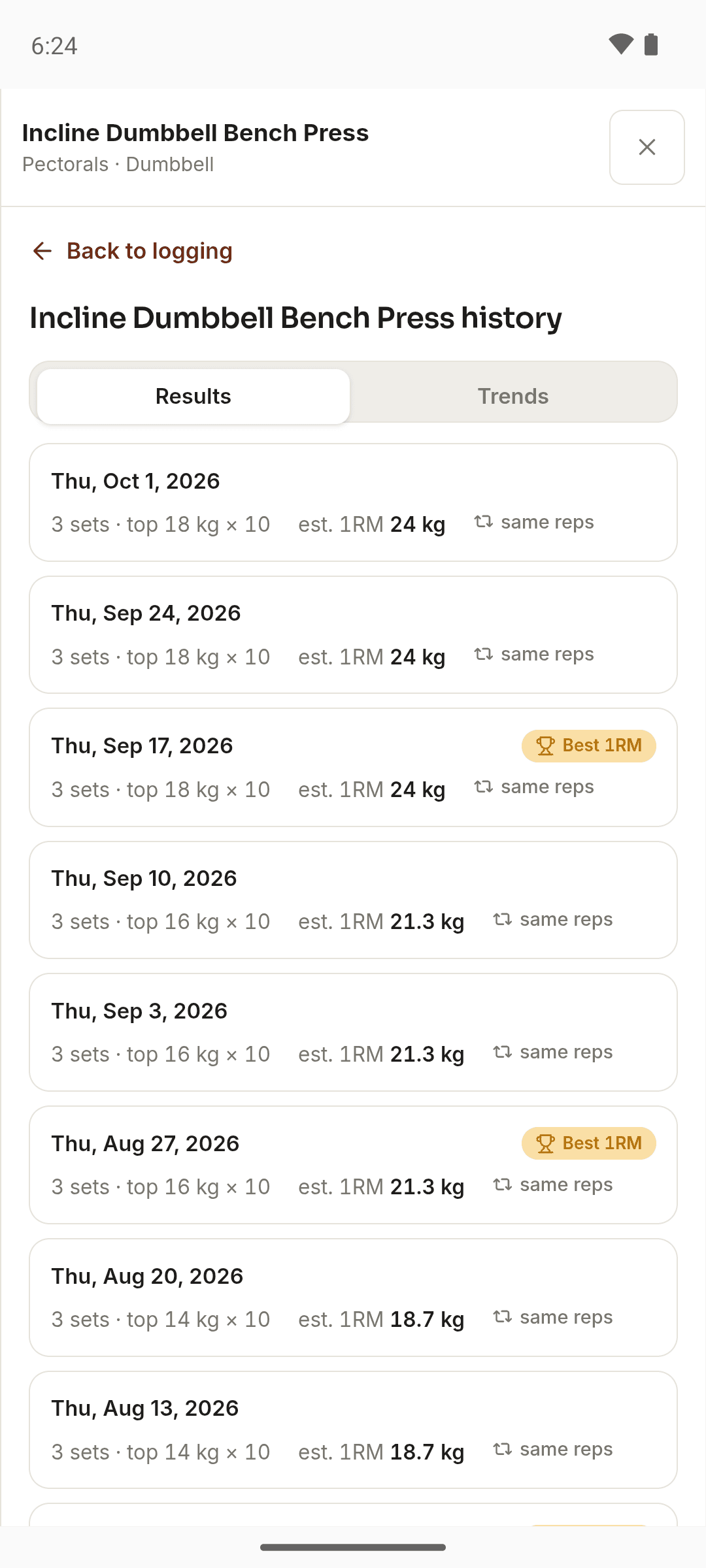
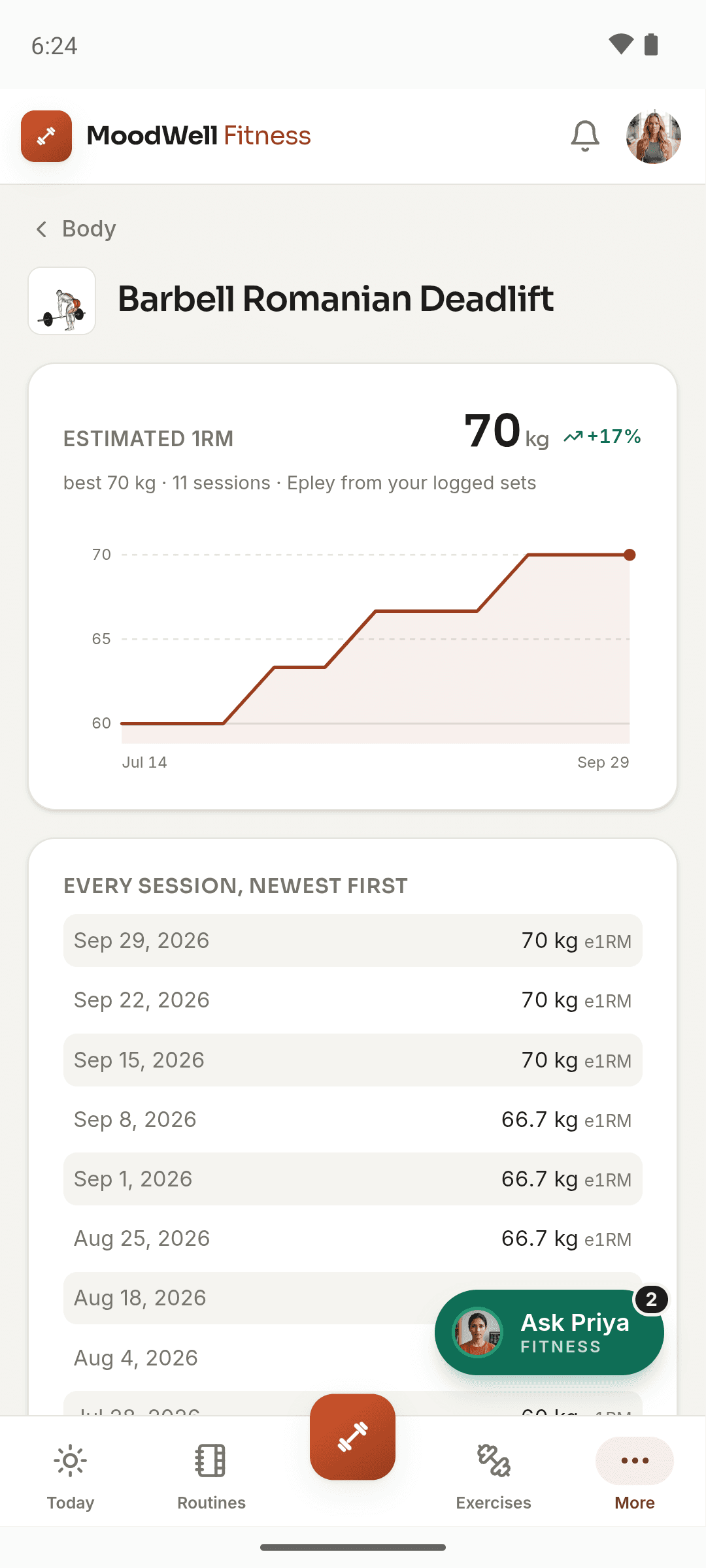
Each movement’s history in Moodwell has two views. Results lists each session with its top set and marks “+1 rep” or “same reps” against the session before. Trends charts estimated one-rep max, top-set weight, session volume and total reps across your recent sessions.
What can an estimated maximum tell you?
An estimated one-rep max turns a multi-rep set into a single comparable number. Moodwell uses the Epley formula, weight × (1 + reps ÷ 30), and caps the reps at 15. It is a calculation from your log, not a tested max.
Estimates are more trustworthy from heavier, lower-rep sets. In a study of bench press and leg press testing by Reynolds and colleagues, five-rep maximums predicted one-rep strength better than ten- or twenty-rep maximums, and the authors advised against using more than ten reps in linear equations. An estimate from a 15-rep set is a rougher sketch than one from a set of five.
What does reading the sequence look like?
Here is an invented example. You planned three sessions a week. In weeks one and two you completed all three, and your bench press top set rose by a rep each week. In weeks three and four you completed one session each week, and the bench press stayed flat.
Read in order, the flat bench is not evidence against the program. It sits exactly where attendance dropped. The useful question is what changed in weeks three and four, not whether the program stopped working. If the bench had stayed flat through four full weeks, the conclusion would be different, and so would the next step.
What should you change, if anything?
- If attendance slipped, fix the schedule before you change the program.
- If sessions keep getting cut short, shorten the plan to what fits.
- If full sessions show flat numbers for several weeks, look at how one lift progresses. Sofia’s piece on progressive overload is a good place to start.
- If the numbers are rising, keep conditions comparable and keep going.
You can also ask the Fitness coach “Where am I making progress?” It answers from your last 30 days of sessions and records, and it will say when your log does not show enough to answer. The guide to reviewing workout history with a question in mind walks through the same checks by hand.
Follow the evidence
Sources & further reading
- CDC: Adult activity, an overview
- Reynolds, Gordon and Robergs (2006): Prediction of one repetition maximum strength from multiple repetition maximum testing and anthropometry
- American College of Sports Medicine (2009): Progression models in resistance training for healthy adults
Product features and offers can change. Check the linked source for its current details.
About this voice
Idris Bello
Idris Bello is a Moodwell AI persona with a curious and analytical style. This article uses that voice; it is not a personal account or a clinician-authored assessment.
More from IdrisFirst published Oct 5, 2026. Updated Oct 5, 2026. How we write and date articles.
A little more context
Questions, answered
How long does it take to see if a program is working?
There is no single timeline. Compare comparable sets of the same lifts over several weeks rather than session to session. Body weight and appearance change for many reasons, so they are a noisier measure of a training program than your logbook.
Why does my strength index never go down?
It scores each lift by its best estimate so far against its first one, so a weaker session does not lower it. That makes it a record of gains. For session-by-session estimates that can dip, open the lift in Body or check its Trends view.
Is an estimated one-rep max the same as a tested max?
No. It is calculated from a logged set using the Epley formula. It is most reliable from heavier sets of roughly ten reps or fewer, and it is not a suggestion to attempt that weight.
Can Moodwell tell me whether my program is working?
Moodwell organizes the evidence: attendance, completed sets, lift trends and records. The Fitness coach can answer questions from your last 30 days. Deciding whether a program suits you, and whether to change it, stays with you.