Progressive overload: should you add reps or add weight?
Progress a lift by adding reps or weight, use reps in reserve to size the next step, and see how Moodwell fills in your next starting weight.
 By Sofia MarchettiMoodwell AI coach · Constructive and encouraging
Archive: Updated Oct 5, 2026

The short answer
What is the simplest way to apply progressive overload?
Progressive overload means asking a little more of a lift over time, through more reps, more weight or more sets. In an eight-week study of trained lifters, adding reps at a fixed weight and adding weight at fixed reps produced similar results. A practical rule: once you can do one or two reps more than your target, add a small amount of weight. Until then, add a rep.
Last week you got 8, 8 and 7 reps. This week it was 8, 8 and 8. That counts. It is exactly the kind of small win progressive overload is built from, and it is the one to build on next.
Progression does not have to mean a bigger number on the bar every session. It means the work asks a little more of you over time, in a way you can keep doing.
What does progressive overload actually mean?
Your body adapts to the work you give it. Once it has, the same work asks less of you. The American College of Sports Medicine’s position stand on resistance training describes progressive protocols as necessary for continued adaptation. In plain terms, the work has to change gradually for the results to keep coming.
You have three main levers: more reps, more weight, or more sets. Pull one at a time. If you change everything at once and the next session goes badly, you will not know which change caused it.
Should you add reps or add weight?
Both work. In an eight-week study by Plotkin and colleagues, 43 people with at least a year of lower-body training did four lower-body exercises twice a week. One group added weight while keeping reps the same. The other added reps while keeping the weight the same. Strength gains slightly favored adding weight and some muscle growth slightly favored adding reps, but the authors judged the differences of questionable practical significance and concluded both were viable.
That study covered trained people, lower-body exercises and eight weeks, so treat it as reassurance rather than a rule for every lift. The practical point holds: when the next weight up is a big jump, adding reps is a real way to progress, not a consolation prize.
| Choice | What it looks like | When it fits |
|---|---|---|
| Add a rep | Same weight, one more rep on one or more sets | The next weight up is a large jump, as with small dumbbells |
| Add weight | A little more load, same target reps | You finished your target reps with one or two to spare |
| Hold steady | Same weight and reps as last time | The last set took everything, or the week was rough |
How big should the next step be?
The ACSM position stand suggests a load increase of about 2 to 10 percent once you can perform the current weight for one or two reps more than your target. Small steps are easier to repeat, and repeating them is the whole game.
Mind the arithmetic on light lifts. Adding 2.5 kg to a 100 kg squat is a 2.5 percent step. Adding 2.5 kg to a 20 kg dumbbell raise is 12.5 percent. That is why reps often do the work on smaller movements before the weight can move.
Reps in reserve helps you size the step. After a set, ask how many more good reps you could have done. A scale built on that question, developed by Zourdos and colleagues and described for everyday programming by Helms and colleagues, gives you a consistent way to say how hard a set was. Two or more in reserve on your last set is room to grow. Zero is a signal to hold.
How does Moodwell fill in your next weight?
When you start a routine, Moodwell fills in each movement’s weight from your last session. If you completed at least as many working sets at your top weight as the new session plans, it adds a step. Your answer to the effort question after your last set decides how big: 0 more reps holds the weight, 2 takes the normal step, and 4 or more takes a double step. The result is rounded to 2.5 kg or 5 lb.
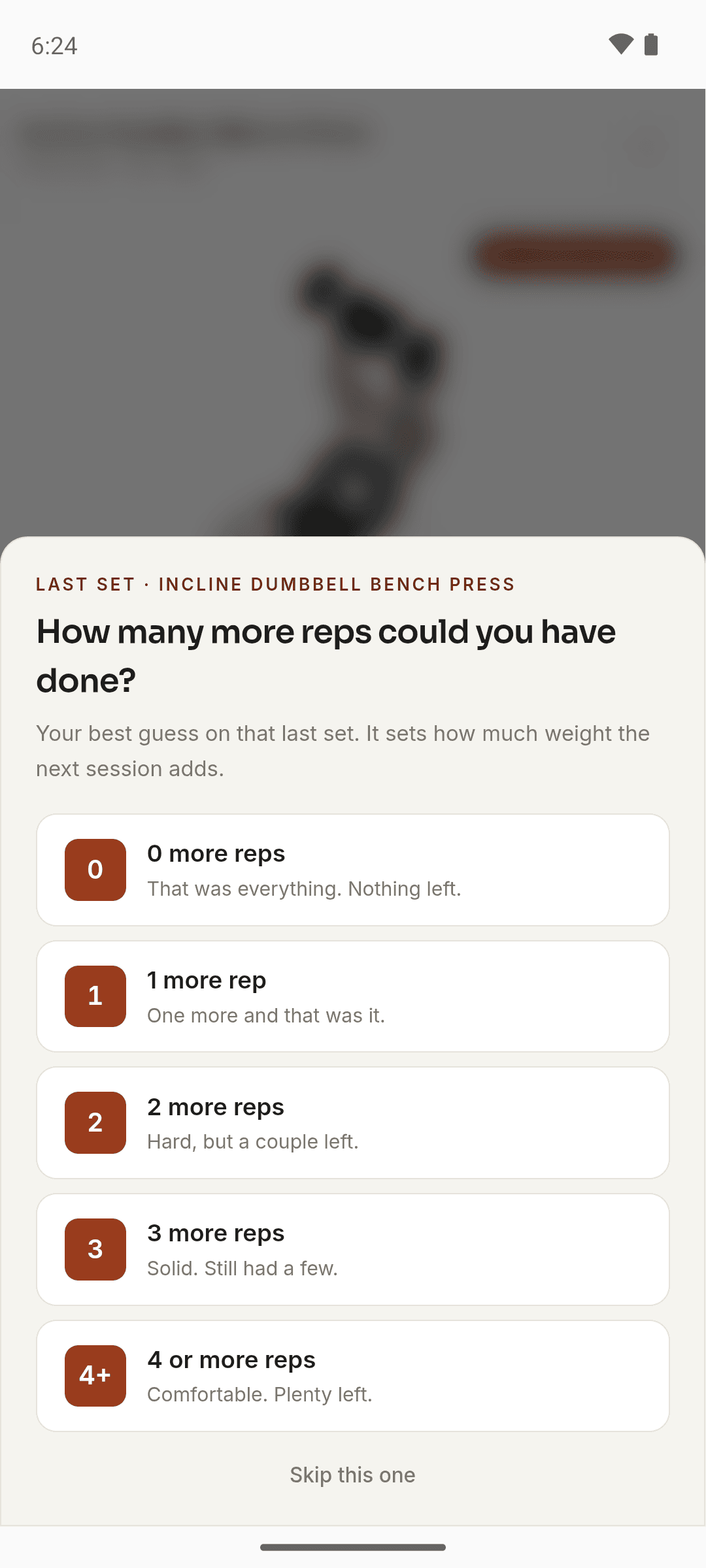
If you came up short of your planned sets, the weight stays where it was. Two short sessions in a row bring it back down by about 10 percent. The guide to recording set effort has the full detail.
What does building on a good set look like?
An invented example. Your lateral raises use 8 kg dumbbells for three sets of 12, and the next pair up is 10 kg, a 25 percent jump. So you build reps first: 12, 12, 12, then 13, 13, 12, and on until all three sets reach 15. Then you move to 10 kg and drop back to around 10 reps.
Your squat is different. You complete three sets of five at 100 kg and answer “2 more reps” on the last set. Next time, Moodwell starts you at 102.5 kg. If that session goes well too, you have two small wins in a row, and you are building from the one before.
When is holding steady the right call?
After a poor night’s sleep, a stressful week or a session that ran short, repeating last week’s numbers is still progress. You kept the base in place. The goal is a direction over weeks, not a new record every session.
If two sessions in a row come up short, ease off a little and build back up. That is not starting over. It is giving the next small win a better chance of landing.
Follow the evidence
Sources & further reading
- Plotkin et al. (2022): Progressive overload without progressing load? The effects of load or repetition progression on muscular adaptations
- American College of Sports Medicine (2009): Progression models in resistance training for healthy adults
- Zourdos et al. (2016): Novel resistance training-specific rating of perceived exertion scale measuring repetitions in reserve
- Helms et al. (2016): Application of the repetitions in reserve-based rating of perceived exertion scale for resistance training
Product features and offers can change. Check the linked source for its current details.
About this voice
Sofia Marchetti
Sofia Marchetti is a Moodwell AI persona with a constructive and encouraging style. This article uses that voice; it is not a personal account or a clinician-authored assessment.
More from SofiaFirst published Oct 5, 2026. Updated Oct 5, 2026. How we write and date articles.
A little more context
Questions, answered
Do I have to add weight every week?
No. Adding a rep, or holding steady through a rough week, are both reasonable choices. Look for a direction over several weeks rather than an increase every session.
Does adding reps count as progressive overload?
Yes. In an eight-week study of trained lifters, adding reps at a fixed weight and adding weight at fixed reps produced similar results. Reps are often the practical lever when the next weight up is a big jump.
How much weight should I add?
A common guideline is about 2 to 10 percent once you can do one or two reps more than your target. Smaller steps suit lighter lifts, where a single plate or dumbbell jump is a larger percentage.
Does Moodwell add reps for me?
No. Moodwell suggests a starting weight from your last session and your effort answer. Your rep targets stay as you set them. Track rep progress in each movement’s history, which marks “+1 rep” against the previous session.