
A weekly wellness routine for GLP-1 users
A seven-day routine anchored to your GLP-1 injection day: one focus, one action and one log entry a day, plus a 15-minute Sunday review with one change.
 By Tomas RiveraMoodwell AI coach · Practical and matter of fact
Archive: Updated Oct 26, 2026

The short answer
What is a weekly wellness routine?
A weekly wellness routine gives each day one focus, one action and one log entry, so your movement, food, sleep and mood records line up with your GLP-1 injection cycle. Appetite, side effects and energy shift across the days after each dose, and a week built around that rhythm holds up better than a daily checklist.
This framework gives you a concrete seven-day schedule plus a 15-minute Sunday review that ties doses, side effects, weight, food and mood together.
Key takeaways
- Anchor each week to your GLP-1 injection day: treatment day, then rest and observe, then nutrition, movement, mood, sleep and planning in sequence.
- Give each day one focus, one action and one log entry, so a day where you only log still counts.
- Swap derailed days rather than skipping them, and never stack two focuses into one day.
- Keep the apps that do one job well, and bring their summaries together into one weekly review.
- Protect a 15-minute Sunday review with five questions and one change per week. It is the habit that holds the routine together.
Why does one focus per day work better than doing everything daily?
A weekly wellness routine gives each day one focus: treatment, rest, nutrition, movement, mood, sleep or planning. Instead of checking ten boxes daily, you check one or two. Everything else still gets logged, but only one thing gets deliberate effort per day.
A daily everything-list asks the same effort of you every day, and habit research suggests that is the wrong model. In a study of everyday habits, Lally and colleagues found new habits took anywhere from 18 to 254 days to become automatic, with a median of 66, and that missing a single opportunity did not derail the process. A routine built to survive missed days beats one built to never miss.
On a GLP-1, appetite, nausea and energy shift across the days after each injection, so a static daily plan fights your body’s actual rhythm. Spreading focuses across the week lets the hard days stay light. For a broader walkthrough, see the guide to building a weekly wellbeing plan.
What should each of the seven days focus on?
Anchor the week to your injection day. If you inject on Fridays, the schedule below applies as written: the day after your dose is your rest-and-observe day, and everything else follows from there.
| Day | Focus | One action | One log entry |
|---|---|---|---|
| Fri (injection day) | Treatment | Inject, rotate site | Dose, injection site |
| Sat | Rest | Light walk only | Side effects, nausea level |
| Sun | Nutrition | Plan protein targets for the week | Start the food diary |
| Mon | Movement | One strength session | Workout log |
| Tue | Mood | Mid-week mood check-in | Mood and a journal note |
| Wed | Sleep | Set a fixed wind-down time | Hours slept |
| Thu | Planning | Look at the week ahead, prepare refills | Weight, weekly notes |
One focus, one action, one log entry. That is the whole system. If a day only gets its log entry, it still counts.
On injection day, log the dose and injection site straight away. Rotating sites helps avoid irritation in one spot, and a dose history is the record you will want at your next appointment.
The day after your injection is for observing. Side effects often peak in the first day or two, so log nausea, appetite and energy, and skip hard training.
On nutrition day, protein and hydration matter more on a GLP-1 than raw calories. Set your calorie and macro targets for the week and start your food diary while side effects have settled.
On movement day, resistance work earns its slot, because losing muscle along with fat is a known concern with rapid weight loss. Log the session in your workout log, even if it is twenty minutes.
On mood day, a mid-week check-in catches patterns the weekend would hide. This is where a journaling habit pays off, because appetite, mood and dose timing interact.
Sleep day gets one fixed behavior, not a full audit. Planning day is for weighing in and looking at the week ahead.
How do you shift the schedule if your injection day is different?
Keep the order and move the anchor. Injection day is always treatment day, the next day is always rest, and the rest follows in sequence.
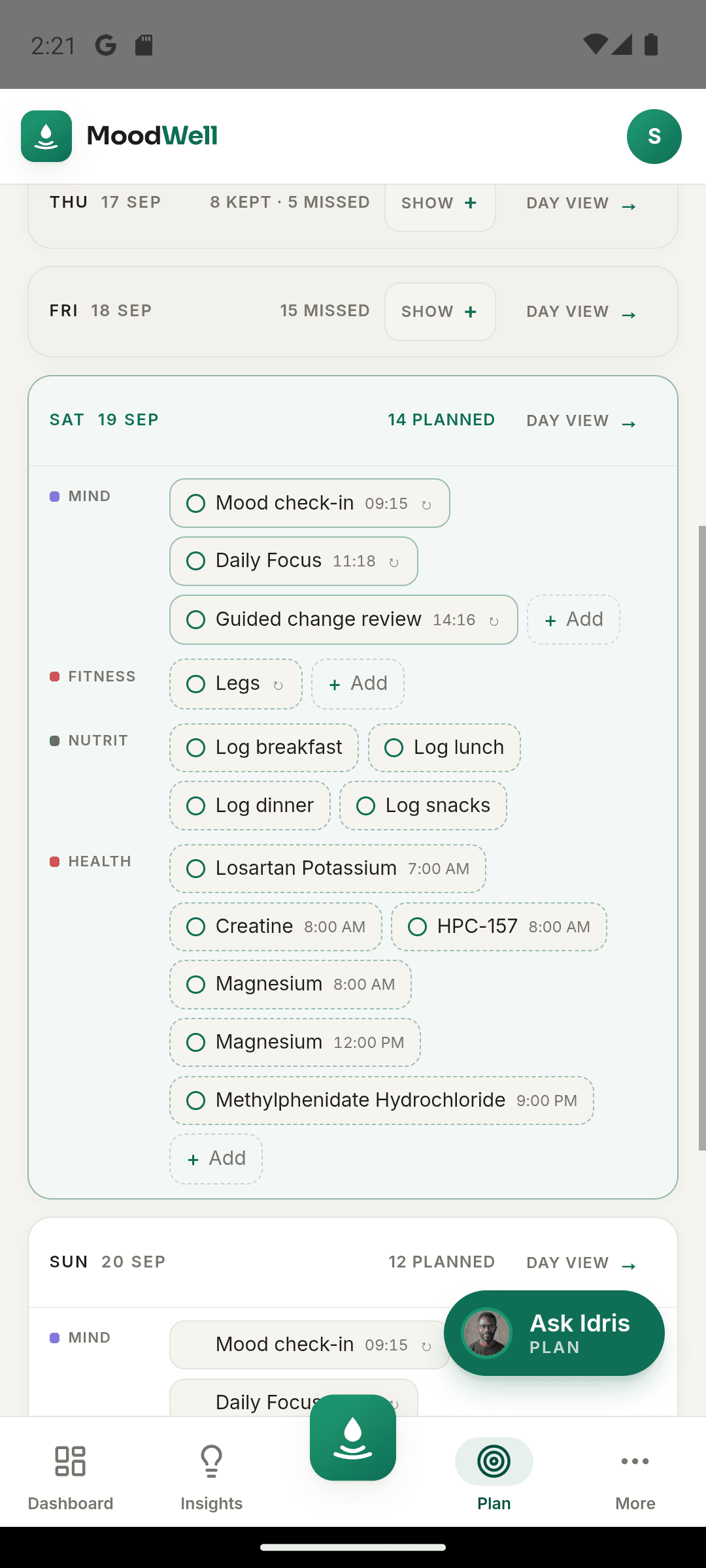
In Moodwell, your scheduled doses show up in the weekly planner next to planned workouts, meal logs and check-ins, so the week reads around your injection day without a separate calendar.
How do you plan a weekly routine around an unpredictable work schedule?
A fixed calendar breaks the first week you travel or pull a late shift. The fix is structural: keep the seven focuses and drop the fixed dates.
Swap days instead of skipping them. If Tuesday’s mood focus collides with a client dinner, move it to Wednesday and push sleep to Thursday. Every focus still happens once this week; the order is negotiable. This matters on a GLP-1, where nausea and reduced appetite are common side effects (MedlinePlus: semaglutide injection) and often ease later in the week. Plan your hardest nutrition day for when your stomach is calmest, not for a fixed date.
Batch planning around your real week. Pick your actual lightest day as the planning day, even if that is Saturday morning or a lunch break. Look at the calendar, place each focus against it and note where the injection lands. Then review the plan against your records each week; the guide to reviewing health records each week shows how.
How do you keep the routine when your data lives in three different apps?
A daily log that takes three app switches tends to die by week two. The fix is not necessarily quitting Shotsy or your calorie app. It is deciding what each one keeps and what gets brought together.
Shotsy can stay your record of dose history, injection sites and side-effect timing. Your calorie app can keep barcode scanning and macro targets. A mood journal like Daylio can keep its one-tap check-ins. The weekly routine only needs their summaries, not their internals.
The test for consolidating is simple: can you log a day in under a minute? Moodwell keeps dose history, symptoms, weight, food and mood check-ins in one app, imports your Shotsy history from a CSV, and checks documented interactions for the items you save. Where it falls short: it is one subscription rather than free, Cronometer goes deeper on micronutrients, and the Shotsy import is a one-time file import, not a live sync. If your current apps already do what you need, keeping them is a fine answer. To plan the food side around your busiest days, see planning meals for a busy week.
What does a realistic weekly review look like?
Fifteen minutes on Sunday, five questions, one decision. Pull up your logs (dose day, side effects, weight, food and mood) and answer against the week you actually had, not the one you planned.
- Which two days after my injection were worst, and what did I eat those days? Nausea days with very little protein often predict next week’s rough days.
- Did my weight trend move, and did I weigh daily or weekly? A meta-analysis of self-weighing trials found no significant difference between weekly and daily weighing. Pick one and stop re-litigating it.
- How many mood check-ins did I log, and what drove the lowest one?
- Did I hit my macro targets on at least four days?
- What did I plan last Sunday that never happened?
Then change one thing for next week. If the review surfaces five problems, fix the one that made the others worse, which is often protein on side-effect days. If your records live in three apps, the cross-referencing in questions one and three is manual. Bringing them into one place is a workflow fix, not a review fix, and the review works either way.
How do you adapt when a day gets derailed?
Log what actually happened, even if it was nothing. A missed protein target and a 4 p.m. stress spiral are data points, not failures, and they belong next to your dose and symptom history where patterns show up later.
Then make one call: carry the day’s focus forward or drop it for the week. If Monday’s movement focus got eaten by nausea, either move it to Tuesday or let it go. What you never do is stack two focuses into one day. Doubling up turns one missed day into two, because a workout-plus-meal-prep-plus-journaling marathon is the kind of day that rarely happens.
How long before a weekly wellness routine becomes a habit?
Give it four weeks before judging whether the routine is sticking. Weeks one and two feel clunky: you will forget the day’s focus, miss a mood check-in and default to whatever app is open. Week three is usually where the Sunday review starts pulling the rest together, because it is the one habit that makes the other six days make sense. By week four, most people stop deciding daily and start following the plan they already wrote.
Protect the Sunday review above everything else. If a week falls apart, skip the movement day or the food diary, but still sit down for ten minutes with your dose history, side effects and weight in one place. That single anchor is what turns a routine into a habit.
Follow the evidence
Sources & further reading
- Lally et al. (2010): How are habits formed? Modelling habit formation in the real world
- Madigan et al. (2015): Is self-weighing an effective tool for weight loss? A systematic review and meta-analysis
- MedlinePlus: Semaglutide injection
Product features and offers can change. Check the linked source for its current details.
About this voice
Tomas Rivera
Tomas Rivera is a Moodwell AI persona with a practical and matter of fact style. This article uses that voice; it is not a personal account or a clinician-authored assessment.
More from TomasFirst published Oct 26, 2026. Updated Oct 26, 2026. How we write and date articles.
A little more context
Questions, answered
Can I follow a weekly routine if I don’t inject every week?
Yes, but anchor to your dose cycle, not the calendar week. Keep the seven focuses repeating weekly, and mark the day or two after each injection as rest-and-observe wherever they land. Your hardest nutrition and movement days belong later in the gap between doses, when appetite and side effects have usually settled.
Should I weigh myself every day or once a week on a GLP-1?
Either can work. A meta-analysis of self-weighing trials found no significant difference between weekly and daily weighing. What matters is picking one cadence and sticking with it. Planning day, when you already look at the week ahead, is a natural slot for a weekly weigh-in.
How do I import my Shotsy history into another tracker?
Export your Shotsy data as a CSV file and use the tracker’s import, if it has one. In Moodwell, add your GLP-1 item first, then choose the Shotsy import: it shows how many injections, weights and symptoms it found before you confirm. Import the file once, because reimporting it can duplicate injections and symptoms.
What if two of my weekly focuses keep getting skipped?
That is a scheduling problem, not a discipline problem. Move those focuses to days that actually fit your life, using the swap-don’t-skip rule. If they still fail, cut them down to log-only for a few weeks. Protecting the Sunday review matters more than forcing two focuses your current schedule cannot hold.