
Breathing, grounding and reflection tools for everyday moments.
Choose from Moodwell's wellbeing tools for breathing, emotional awareness, reflection, focus and gratitude. Browse by what you need, from a paced breathing exercise to a thought reframe or a small next step.
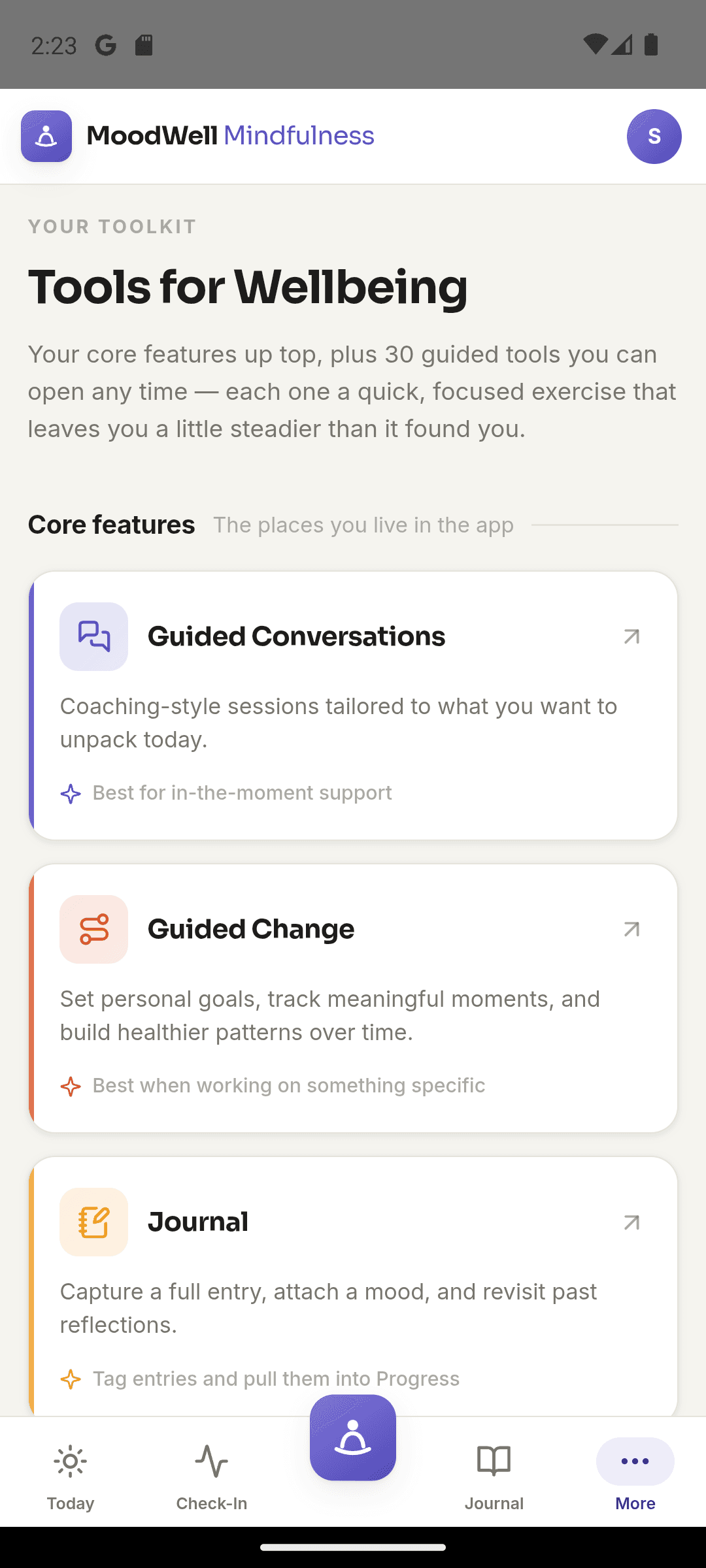
What it helps you do
What can you do with Wellbeing tools?
Find a place to start
Choose regulation, awareness, reflection, action or positivity to narrow the tool library.
Match the exercise to the moment
Try breathing for a short pause, an emotion tool for clearer language or a next-step tool for a decision.
Know when AI is involved
The catalog marks AI-assisted tools so you can distinguish them from timers and guided exercises.
Step by step
How Wellbeing tools works
Choose what you need
Decide whether you want to pause, name a feeling, explore a thought or make a start.
Open a tool
Read its instructions and follow the breathing, selections, writing prompts or timed exercise.
Review and finish
Complete the exercise, read any AI support and record a check-in or journal entry if you want to keep more context.
Inside the app · Wellbeing tools
Find a small exercise for the moment you are in.
Browse by the kind of support you want, then choose an exercise you have time for. The library brings breathing, awareness, reflection, action and positivity tools into one place.
- Choose a group to narrow the library to what you need now.
- Explore breathing, emotional awareness, thought reframing and next-step tools.
- Follow the selections, writing prompts or timed instructions in each exercise.
- See which tools use AI assistance and credits before requesting generated support.
Save the context when it matters
A check-in or journal entry can preserve what was happening before or after a tool.
The complete library
Which wellbeing tools can you use?
Choose a group, then find an exercise for the time and attention you have. AI-assisted tools use credits for generated support.
Breathing and regulation
Follow a paced breath, move attention through your body or use a short grounding exercise.
- Breathing CoachNo AI request
- Box Breathing TrainerNo AI request
- 4·7·8 Breathing GuideNo AI request
- Grounding 5·4·3·2·1AI-assisted
- Nervous System ResetNo AI request
- Progressive Muscle RelaxationNo AI request
- Micro MeditationNo AI request
- Body Scan ResetAI-assisted
- Overwhelm ResetNo AI request
Emotional awareness
Find a more precise word for a feeling, explore its intensity or identify what brought it on.
- Mood Check-In CompassAI-assisted
- Emotion Wheel SelectorAI-assisted
- Emotion Naming ToolAI-assisted
- Trigger IdentifierAI-assisted
- Energy Awareness TrackerAI-assisted
- Feeling Orientation MapAI-assisted
Reflection and insight
Examine a thought, try another perspective or work through prompts about an experience.
- Thought Reframe ToolAI-assisted
- Guided Reflection PromptsAI-assisted
- Perspective ShifterAI-assisted
- Cognitive Distortion DetectorAI-assisted
Action and momentum
Choose a small next step, start a timed focus session or take a guided reset walk.
- Tiny Action GeneratorAI-assisted
- Next Step ClarifierAI-assisted
- Focus Sprint TimerNo AI request
- Reset Walk GuideNo AI request
- Momentum BuilderAI-assisted
- Motivation SparkAI-assisted
Growth and positivity
Record gratitude, recognize a small win, revisit a memory or plan an act of kindness.
- Gratitude BuilderAI-assisted
- Daily Wins TrackerAI-assisted
- Positive Memory VaultAI-assisted
- Kindness GeneratorAI-assisted
- Compliment BuilderAI-assisted
Before you start
Availability and things to know
Where you can use it
- Available on Android
- Available in the desktop web app
Things to know
- Wellbeing tools support self-reflection and coping; they are not treatment or emergency support.
Keep exploring
More in Moodwell Mindfulness.
Mood tracker
Check in with your mood in Moodwell, record stress and energy, and add the context you want to remember. Review your mood history to see how your days have felt over time.
Journaling
Write journal entries in Moodwell, attach a mood or context, and return to past reflections. When you want help exploring an entry, request an AI reflection on what you have written.
Guided conversations
Explore a difficult meeting, decision or recurring thought with a guided AI conversation in Moodwell. Keep the session together as you answer questions, reflect on what matters and consider a next step.
Guided Change
Set a personal goal in Moodwell Guided Change and record the moments that relate to it. Review attempts, setbacks and progress over time, with AI insights when you want help reflecting on your history.
Thought Reframe
Write a thought in Moodwell's Thought Reframe tool, rate how true it feels and choose the tone that fits it. Review alternative reframes, select one you can believe and receive AI support for your reflection.
Daily Focus
Moodwell Daily Focus turns a short check-in into an AI-generated plan for today. Share how you feel, the area on your mind and the quality you want to bring to it, then choose from three suggested focus actions.
Daily Positivity
Moodwell Daily Positivity starts with how the day feels, the kind of support you want and one honest observation. It creates an AI-guided reflection with three short activity ideas and a moment to pause and savor.
Get started with Wellbeing tools.
Choose a mobile platform to see its current release, beta, or waitlist option.
Questions, answered
Wellbeing tools, explained.
Choose between a simple exercise, a place to write, and an optional AI-guided tool.
Explore all FAQsWhich wellbeing tools are included?
The library has five groups: regulation, emotional awareness, reflection and insight, action and momentum, and growth and positivity. The complete catalog on this page lists each tool.
Do all wellbeing tools use AI credits?
No. Paced breathing, Focus Sprint Timer and several guided exercises work without an AI request. Tools marked AI use credits for their generated support.
How do I choose between journaling and a wellbeing tool?
Choose journaling when you want room to write freely. Choose a tool when a specific structure would help, such as naming an emotion, reframing one thought or choosing a next step.